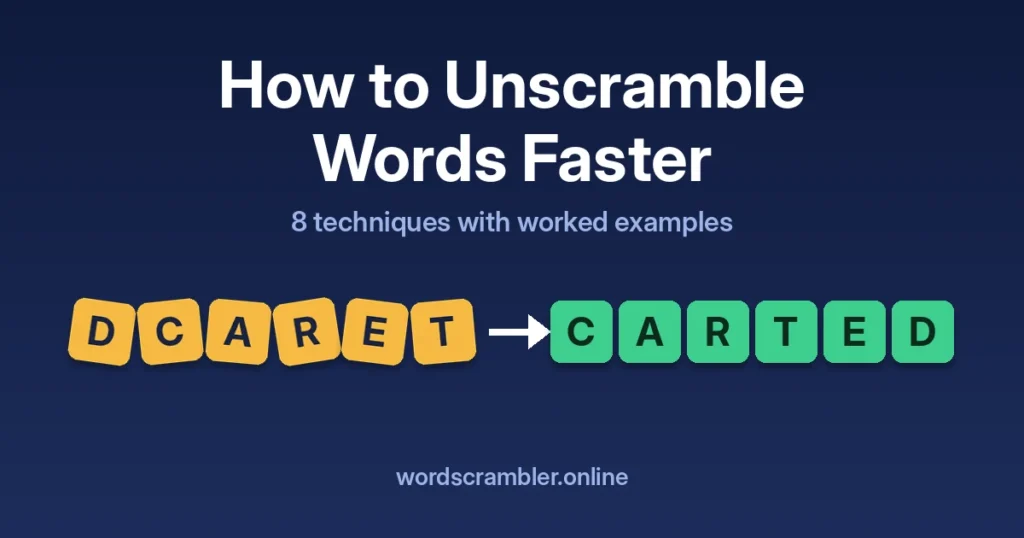
The fastest way to unscramble words is to stop reading the letters in the order you were given. Shuffle them, split the vowels from the consonants, lock common letter pairs, and test prefixes and suffixes before you guess. This guide gives you eight techniques, each with a worked example, plus a simple rule for when to hand a stubborn rack to a free tool.
How to Unscramble Words: Techniques 1 to 4
Each technique below works on its own. Together they turn a blank stare into a short checklist you can run in your head.
1. Break the order first
Your eye keeps re-reading the shape it already sees. Rewrite the letters in a new line, write them in a circle, or shuffle the tiles on your rack. A fresh order clears the stuck picture and lets new combinations show up.
Example: the rack EDACRT looks like nothing. Rewrite it as CARTED and the word jumps out. Rewrite it again as REDACT and a second answer appears. One scramble can hide several real words, so keep going after your first hit. Want racks to practice on? Make your own with the word scramble generator.
2. Split the vowels from the consonants
Two small piles are easier to read than one jumble. Move the vowels to one side and the consonants to the other. The balance tells you roughly how many syllables to expect and where the vowels probably sit.
Example: take RETINAS. The vowels are E, I, A and the consonants are R, T, N, S. Three vowels and four consonants suggests a seven letter word that alternates, such as RETAINS or NASTIER. Both use exactly the same seven letters.
3. Lock the common letter pairs
Some letters travel together. TH, CH, SH, ST, BR, TR and PL show up at the start of words all the time, while CK, NG and NT cluster at the end. When you spot a pair, tape it together as one block and arrange the rest around it.
Example: the letters S, H, A, R, P contain SH. Put SH at the front and you get SHARP. Put the same letters in a different order and you get HARPS.
4. Peel off prefixes and suffixes
Most long words are a short core wrapped in familiar parts. Scan for endings like ING, ED, ER, EST and TION, and for beginnings like RE, UN, PRE and DIS. Remove them, solve the short core, then put them back.
Example: with D, C, A, R, E, T, pull out the ending ED. That leaves C, A, R, T, which makes CART, so CARTED is one answer. The same six letters also make TRACED, CRATED and REDACT.
Faster Ways to Unscramble Words: Techniques 5 to 8
The first four techniques give you a way in. These four help you finish and check the job.
5. Place the rare letters first
Awkward letters have very few homes. A Q almost always needs a U beside it. A lone J, X or Z fits into far fewer words than an E or an S. Decide where those go first and the common letters fall into place around them.
Example: the rack T, E, I, U, Q has a Q, so glue QU together first. Now you only need to arrange T, E and I after it, which gives QUIET or QUITE.
6. Build from a small word, then extend
Do not try to see the whole word at once. Find any short word hiding in the letters, then ask what the leftover letters add.
Example: the rack D, N, G, A, E, R hides the word DANG. The leftovers are E and R, and DANG plus ER makes DANGER. Try another short word, RANG, and the leftovers E and D give you RANGED. The same six letters also make GARDEN and GANDER
7. Check that every letter is used
A true anagram uses every letter exactly once. That is the standard definition in Merriam-Webster, and it gives you a fast test for your answer. Count the letters in the puzzle, count the letters in your word, then make sure each letter appears the same number of times.
Example: LISTEN and SILENT both use L, I, S, T, E, N once each, so they match. GARDENS does not match GARDEN, because the extra S has nowhere to go. In a board game you only need a subset of your tiles. In an anagram puzzle you need all of them.
8. Know when to hand it to a tool
Give each rack about a minute, then stop. Staring longer rarely helps, because your brain keeps replaying the same arrangement. Type the letters into a word unscrambler and read the full list it returns. The point is not to skip the thinking. Look at the words you missed, spot the pattern behind them (a suffix, a letter pair, a small word you overlooked), and you will catch it yourself next time.
Which Word Unscrambler Should You Use?
The three tools below take the same input but return different results. Pick the one that matches your puzzle.
| Tool | What it returns | Best for |
|---|---|---|
| Word Unscrambler | Words from any of your letters, ranked by tile points | Scrabble and Words with Friends racks |
| Word Descrambler | Every valid word in your letters, sorted by length | Newspaper and app jumbles |
| Anagram Solver | Words that use every letter, or shorter words if you choose | Anagram puzzles, names and phrases |
All three accept up to 15 letters, and you can type ? or * to stand in for a blank tile. The advanced options let you filter by a letter the word must include, a starting letter or an ending letter. Remember that the unscrambler ranks words by base tile value only, so it does not count double or triple squares on your board. If one tool returns less than you expected, try another before you decide there is nothing there. To confirm a word is valid before you play it, use the Check Dictionary tool.
Unscrambling Wordle Letters
Wordle works differently from a jumble because the game colors your guesses. Green means the letter is correct and in the right place, yellow means it is in the word but in a different place, and gray means it is not in the word. Once you have a few colors, the Wordle Solver lets you enter your green, yellow and gray letters to narrow down the possible five letter words.
A 5 Minute Practice Routine
Speed comes from practice, and a short daily habit beats one long session.
- Pick five scrambled words. The free printable word scramble worksheets include 50 words across five themes, with an answer key.
- Give each word 60 seconds and use the techniques above in order.
- Note which technique cracked each word. You will find that one or two do most of the work for you.
- Type any misses into a tool and study the answers.
- Repeat tomorrow with five new words.
FAQ
What is the fastest way to unscramble words?
Reshuffle the letters into a new order, split the vowels from the consonants, lock common letter pairs and peel off prefixes and suffixes. If nothing works after about a minute, type the letters into a word unscrambler and study the list it returns.
Is using a word unscrambler cheating?
That depends on the rules of what you are playing. For solo puzzles, practice and learning new words, it is a study aid. In a match against another person who expects you to play unaided, it breaks fair play, so check the rules of your game first.
What is the difference between unscrambling a word and solving an anagram?
A true anagram uses every letter exactly once. Unscrambling is often looser, because in a board game you only need a word made from some of your tiles. The Anagram Solver covers the strict case and the Word Descrambler covers the loose one.
How can I get better at unscrambling words?
Practice short timed sets every day, learn the common prefixes, suffixes and letter pairs, and review the words a tool finds that you missed. After a few weeks you will start to spot those patterns without help.