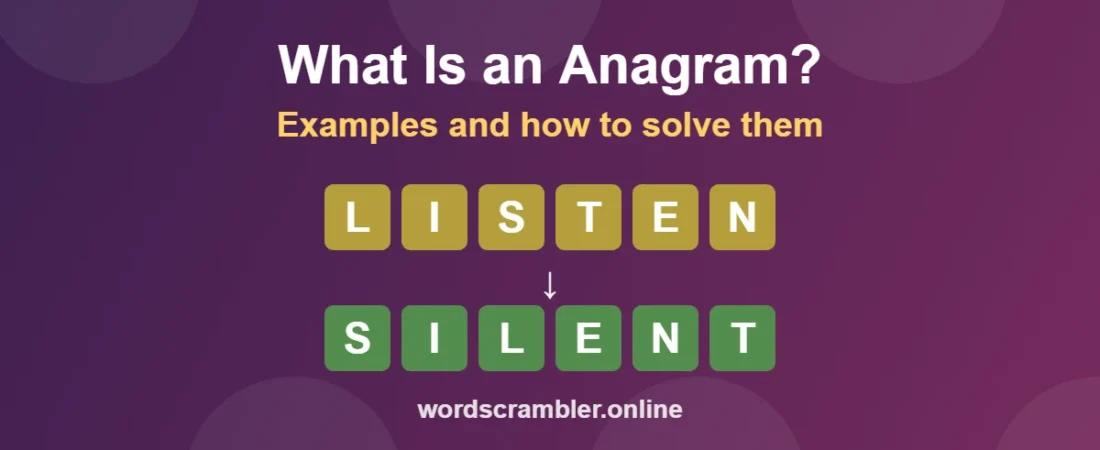
What is an anagram, and why do word games love them? You have probably seen one without noticing. “Listen” and “silent” use the same letters, and so do “lemon” and “melon”. Once you spot the trick, you see it in word games, books, and crossword clues.
This guide answers the question “what is an anagram” in plain words. You will see clear examples, learn the rules, and get a step-by-step method for solving anagram puzzles.
Quick answer: An anagram is a word or phrase made by rearranging the letters of another word or phrase. You use every original letter exactly once. For example, “listen” becomes “silent”. The new word or phrase should be real, and it usually has a different meaning.
What Is an Anagram? A Simple Definition
Merriam-Webster defines an anagram as a word or phrase made by rearranging the letters of another word or phrase. The same entry lists a second meaning: a game where players build words by reshuffling letters.
The word itself comes from New Latin anagramma, built from Greek parts that include gramma, meaning “letter”. Merriam-Webster dates the noun to 1589.
The idea is simple. Take the letters, shuffle them, and make something new. Nothing is added and nothing is left out.
Anagram Examples You Can Check Yourself
The best way to learn is to compare letters side by side. Count them if you like. Each pair below uses the exact same letters.
| Original | Anagram | Type |
|---|---|---|
| listen | silent | Single word |
| lemon | melon | Single word |
| evil | vile, veil, live | One word, several answers |
| the eyes | they see | Phrase |
| dormitory | dirty room | Word to phrase |
| astronomers | no more stars | Word to phrase |
| a gentleman | elegant man | Phrase |
Some of the most famous anagrams come from fiction. In the Harry Potter books, J.K. Rowling turned “Tom Marvolo Riddle” into “I am Lord Voldemort”. Both versions use the same sixteen letters.
Types of Anagrams
People sort anagrams into a few simple groups. These labels are informal, but they help when you are solving or writing your own.
- Word to word: One word becomes another, like “lemon” and “melon”. These are the easiest to check.
- Word to phrase: A single word becomes two or more words, like “astronomers” and “no more stars”.
- Phrase to phrase: Both sides are phrases, like “the eyes” and “they see”.
- Names: A person’s name becomes a new phrase. Writers use this to hide a secret or add a joke.
Good anagrams feel clever because the new phrase fits the original in some way. “Dormitory” turning into “dirty room” is a classic case.
Rules: What Counts as an Anagram
Keep these rules in mind when you check an anagram.
- Use every letter: You cannot drop a letter or add one. The letter count must match.
- Match repeated letters: If the original has two Os, the anagram needs two Os.
- Ignore spaces and punctuation: In phrases, only the letters matter. “Dormitory” has no space, but “dirty room” does.
- Make a real word or phrase: Random letter strings do not count. The result should make sense.
- Meaning can change: Many anagrams have no link in meaning. The best ones comment on the original, which is why people enjoy them.
Anagram vs Word Scramble vs Word Unscramble
These terms overlap, so here is how they differ.
- Anagram: The relationship between two words or phrases that share the same letters.
- Word scramble: A puzzle where the letters of a word are jumbled and you must find the original. Our word scramble generator mixes up any words you enter to make puzzles.
- Unscrambling: The act of solving a scramble. Our word descrambler finds real English words from jumbled letters.
In short, an anagram is the result, a scramble is the puzzle, and unscrambling is the solving.
How to Solve an Anagram Step by Step
A set of five different letters can be arranged in 120 ways. Six different letters give 720 ways. Trying every one is slow, so use clues from the letters instead.
1. Write the Letters Down
Lay out every letter in a row, then in a circle. A new layout often makes a pattern pop out.
2. Look for Common Endings
Pull out letter groups like ING, ED, ER, LY, and S. Set them aside and work on what is left.
3. Pair Common Clusters
Letters often travel in pairs, such as TH, SH, CH, ST, and QU. Spotting one removes two letters from the puzzle.
4. Separate Vowels and Consonants
Count each group. A word with one vowel is built very differently from a word with four.
5. Test and Confirm
Once you find a candidate, check that it uses every letter. Then read it aloud to make sure it is a real word.
Worked Example
Try the letters G, N, I, D, E, A, L. Spot ING first, which leaves D, E, A, and L. Those letters form LEAD, so the answer is LEADING.
Now try N, E, T, S, I, L. This set has several answers: LISTEN, SILENT, ENLIST, TINSEL, and INLETS. One group of letters can hold more than one anagram, so check every clue you have.
For more practice, work through our list of jumbled words with answers, or read our guide on how to unscramble words. Not sure a result is a real word? Confirm it with our dictionary checker.
Quick Tips to Spot Anagrams Faster
Strong solvers train their eyes to notice patterns. This table shows what to look for and an example of each.
| What to look for | Example letters | Result |
|---|---|---|
| Ending ING | G, N, I, D, E, A, L | LEADING |
| Ending ED | D, E, T, R, A, S | STARED |
| Pair TH | H, T, N, O, M | MONTH |
| Prefix RE | R, E, T, U, R, N | RETURN |
Start with the pattern that jumps out first. Then fit the remaining letters around it.
Where You Meet Anagrams
- Word games: Tile games and daily puzzles reward anagram thinking. In Wordle and Quordle, rearranging yellow letters is the same skill.
- Cryptic crosswords: Clues often hide an anagram. A word like “mixed” or “broken” can signal that letters need rearranging.
- Books and film: Writers use anagrams to hide names and plant clues.
- Classrooms: Teachers use jumbled words to build spelling and vocabulary.
Related word games include palindromes, which read the same forward and backward, and pangrams, which use every letter of the alphabet. They also play with letters, but they are not anagrams.
When you need a fast answer, our anagram solver finds words and phrases that use every letter you enter.
What Is an Anagram Good For?
Anagrams are more than a party trick. They sharpen spelling, widen vocabulary, and train your brain to see a letter set in several ways.
That last skill is why anagram practice helps in games like Wordle, Quordle, and tile-based word games. You learn to stop reading a word left to right and start treating its letters as flexible pieces.
Try these short drills to build the habit.
- Name swap: Rearrange the letters of your own name and see what real words appear.
- Five a day: Solve five jumbled words each day, starting with four-letter ones.
- Work backward: Pick a word and write down every other word that uses its exact letters.
- Race a friend: Give each player the same letters and see who finds a word first.
Frequently asked questions
What is an anagram in simple words?
An anagram is a new word or phrase made by rearranging the letters of an old one. You must use all the letters once. “Lemon” and “melon” are a simple example.
Is “listen” an anagram of “silent”?
Yes. Both words use the letters L, I, S, T, E, and N exactly once. Only the order changes.
Can a phrase be an anagram?
Yes. Phrases work the same way as single words. “Dormitory” and “dirty room” use the same letters, as do “a gentleman” and “elegant man”.
What is the difference between an anagram and a palindrome?
An anagram rearranges letters into a different word or phrase. A palindrome reads the same forward and backward, like “level”. The two ideas are separate.
How do I find anagrams quickly?
Group the letters into common endings and pairs, then test the remaining letters. If you want a shortcut, type the letters into an anagram solver or word descrambler. Then study the results to learn the patterns.