Word Unscrambler
Up to 15 letters. Use ? or * for a blank tile.
Word Unscrambler for Scrabble & Words with Friends Tiles
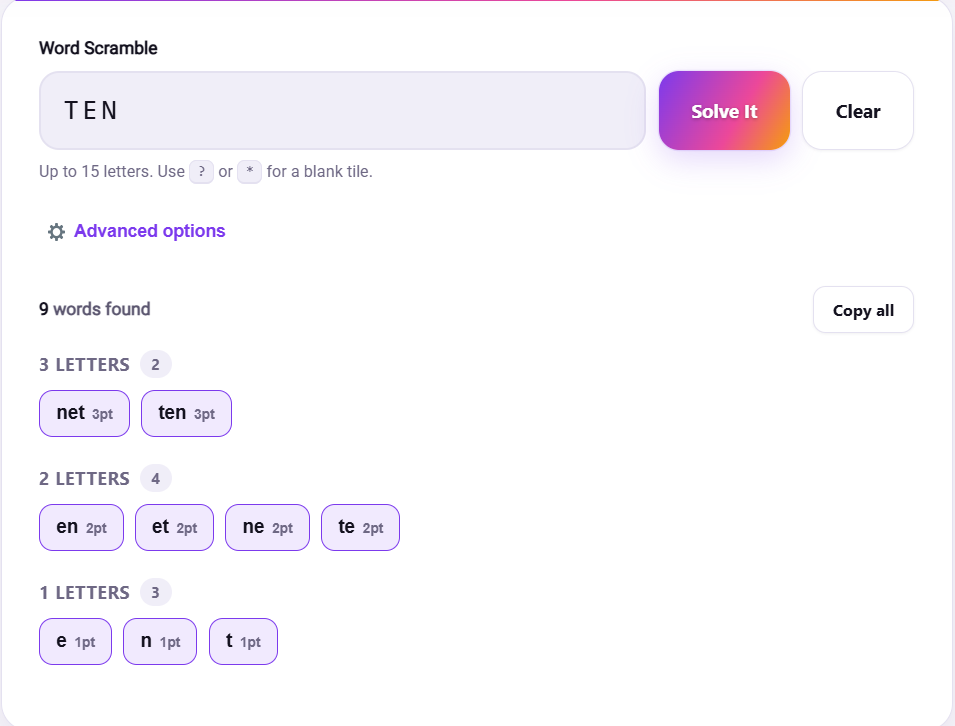
The mistake most people make with a bad rack isn’t playing a weak word, it’s playing the first decent word they spot instead of checking whether a better one was sitting in the same seven tiles the whole time. A word unscrambler fixes that specific problem: type in your tiles, and instead of just one option, you see everything possible, ranked so the highest value play is easy to spot.
Tiles Aren’t All Worth the Same
This is where a tile game unscrambler earns its place over a generic word finder. Scrabble and Words with Friends assign different point values to different letters, a Q or Z is worth far more than an E or an S, based on the official Scrabble tile distribution and point values, and a word unscrambler built for these games accounts for that. Two words of the same length can score very differently depending on which letters they use, so the “best” word isn’t always the longest one, it’s the one that makes the smartest use of your highest value tiles.
Blank Tiles Change the Math
If your rack includes a blank, treat it as a wildcard when you enter your letters, since it can stand in for any letter in the alphabet. A blank is worth zero points on its own, but the word it helps unlock can still score well through the other tiles around it. The tricky part is deciding which letter to assign the blank to, since that choice can open up entirely different words. If you’re stuck, try running your rack through with a couple of different assumed letters for the blank and comparing what comes back each time.
Reading the Board, Not Just Your Rack
A high scoring word on paper isn’t automatically the right play. Board position matters just as much. Landing on a triple word score square, or extending a word into one, can turn a modest word into your best play of the game, while the same word played elsewhere might barely move your score. Before locking in whatever the unscrambler ranks highest, take a second to check whether a slightly lower scoring word actually lands better on the board in front of you.
When Playing It Safe Beats Playing It Big
There’s a case for holding back sometimes. Playing your biggest word early can hand your opponent a wide open board and easy access to premium squares on their next turn. Sometimes the smarter move is a smaller, safer word that keeps the board tighter and denies your opponent easy setups, even if it isn’t the top scoring option available to you. A word unscrambler shows you what’s possible, it doesn’t make the strategic call for you.
If you’re working with a looser jumble outside of a tile game, the Word Descrambler is built for that more general case. And if Wordfeud is your game of choice specifically, the Wordfeud Helper accounts for that game’s own distinct scoring and letter distribution.