Anagram Solver
Up to 15 letters. Use ? or * for a blank tile.
Anagram Solver: Unscramble Every Letter Into Real Words
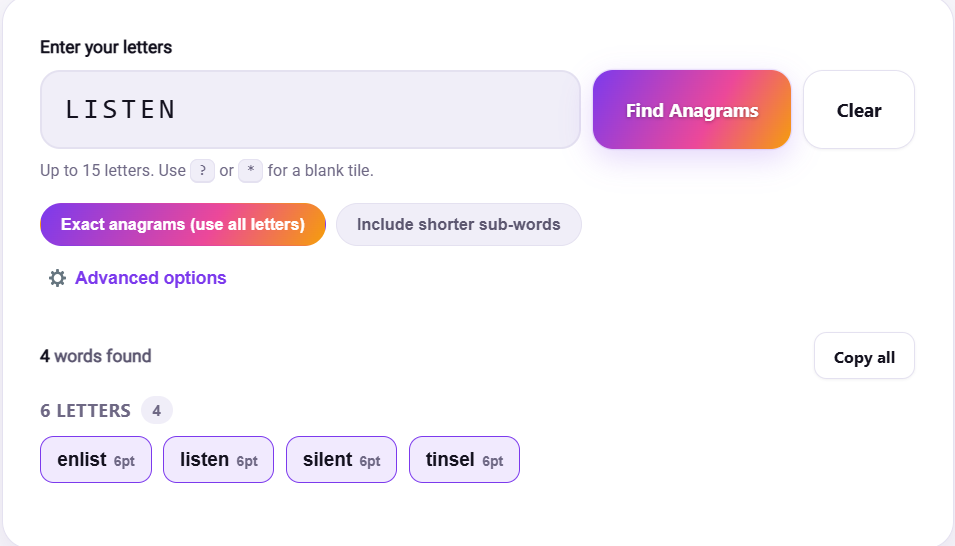
An anagram, technically, is a word or phrase formed by rearranging every single letter of another word or phrase, nothing added, nothing left out. That’s Merriam-Webster’s own definition of the term, and it’s worth knowing precisely, since it’s the strict rule that separates a true anagram solver from a looser tool that just finds words hiding somewhere inside a jumble. LISTEN and SILENT are the classic textbook example, same seven letters, two completely different meanings.
The One Rule That Makes This Different
If you have used a word descrambler before, this might feel familiar at first, and in a lot of ways it is. The difference shows up in the results. A descrambler will happily hand you three letter words buried inside a seven letter jumble. An anagram solver, done properly, only returns words that account for every letter you typed in, with nothing left over. Type in a five letter word and you will only see other five letter words back, never shorter ones, because a true anagram has to use the whole thing.
This matters more than it sounds like it should. If you are trying to solve an actual anagram puzzle, where the challenge is finding the one word or phrase that rearranges completely, a tool that also shows you a pile of unrelated shorter words is just noise you have to filter through yourself.
Single Words Are the Easy Case
Feed the solver a single word and it works exactly as you would expect: type in your letters, hit solve, and get back every valid word that is a complete rearrangement of what you entered. Some words have no anagram at all, plenty of English words are unique enough in their letter combination that nothing else matches. Others, like the LISTEN and SILENT pair, have several. Longer words tend to have fewer full anagrams simply because there are more letters that all need to line up correctly, while shorter words, four or five letters, are more likely to have at least one match.
Phrases Are Where It Gets Genuinely Fun
The more interesting use case, and the one anagram fans actually chase, is turning full names or phrases into something new. This is where you get famous examples like “Elvis” rearranging into “Lives,” or longer phrases spinning into surprisingly fitting new sentences. To solve a phrase anagram, strip out the spaces mentally and treat the whole thing as one long string of letters, then work from there. It takes more letters to work with, which usually means more possible combinations, so results for phrases can take a bit more scrolling through to find the one that actually makes sense as a real answer rather than just a technically valid word list.
If you only need words hiding inside a jumble rather than a complete rearrangement, the Word Descrambler is built for that looser search instead, and the Word Unscrambler works similarly if you are comparing the two.
Where Anagram Solving Actually Comes Up
Word puzzle games built specifically around anagrams, obviously, but also crossword clues that hint at an anagram without saying so directly, a classic cryptic crossword trick. Scrabble and Words with Friends players use it to check whether their current tiles can form one big word rather than settling for a shorter, safer play. And plenty of people just enjoy the novelty of anagramming their own name or a friend’s to see what comes out the other side, sometimes flattering, sometimes not.